Call/ WhatsApp us: 0710942629 / 0736677646 Email: omaadvocates@gmail.com


Verifying a title deed in Kenya means running an Official Land Search through Ardhisasa (in digitised registries like Nairobi) or the physical Land Registry using Form RL 27. The search confirms the registered owner, parcel size, tenure, and any encumbrances such as bank charges, caveats, or court orders. A clean legal transfer under the Land Registration Act, 2012 also requires pairing this search with a physical boundary (beacon) verification and, for higher-value transactions, a Registry Index Map (RIM) audit.
Kenyan conveyancing law operates on the principle of caveat emptor buyer beware. The burden is on the purchaser to prove proper legal checks were done before a deposit changes hands. Buying a fake title, land already charged to a bank, or a parcel tied up in a boundary dispute can mean losing the entire purchase price with little recourse. This is why most buyers instruct a conveyancing lawyer to run the verification rather than relying on the seller’s paperwork alone. Below is the five-step legal verification framework advocates use to confirm clean title before a client commits any money.
Buying Land in Kenya From Abroad?
If you live outside Kenya, this process is harder, not easier. You are relying on photos, a phone call with a seller or agent, and possibly a relative to “have a look.” You cannot easily walk into a registry, confirm a beacon on the ground, or push back in person when a seller stalls on giving search consent.
This is precisely why diaspora buyers lose the most money to land fraud in Kenya the distance itself is the vulnerability that fraudsters rely on. The fix is not to skip verification because you’re far away; it’s to instruct a Kenya-based advocate to run the full five-step process below on your behalf and report back before you send any money. Our cross-border and international lawyers regularly coordinates this kind of remote verification and transaction support for clients purchasing property while based abroad.
The Legal Framework
Property transactions and land rights in Kenya are governed primarily by the Land Registration Act, 2012 and the Land Act, 2012, alongside the Law of Contract Act for the agreements underpinning any sale or lease. Sectional titles fall under the Sectional Properties Act, 2020, and development approvals engage the Physical and Land Use Planning Act, 2019. Stamp duty on transfers is governed by the Stamp Duty Act. Together, these statutes determine how a title is verified, how a transfer becomes legally binding, and what protections apply to buyers, sellers, landlords, and tenants.

The 5-Step Legal Title Verification Framework
| Stage | Portal / Authority | Document Obtained | Risk Mitigated |
|---|---|---|---|
| 1. Ownership & Encumbrance Search | Ardhisasa / Ministry of Lands Registry | Official Search Certificate | Impersonation, hidden bank charges, court caveats |
| 2. Physical Boundary Verification | Survey of Kenya / Licensed Surveyor | Registry Index Map (RIM) & Beacon Certificate | Non-existent land, wrong boundaries, road reserves |
| 3. Municipal & Tax Status | County Government & KRA | Land Rates & Land Rent Clearance | Inherited statutory tax liabilities and liens |
| 4. Historical Chain of Title | Ministry of Lands Archives | Historical Parcel Green Card | Forged titles, illegal double-allocations |
| 5. Transactional Consent | Land Control Board (LCB) / NLC | LCB Consent to Transfer | Void transactions under the Land Control Act |
Step-by-Step: Conducting an Official Land Search
Digital Search via Ardhisasa (Nairobi & Digitised Registries)
Ardhisasa is the Ministry of Lands and National Land Commission’s digital platform for land administration and is fully operational in Nairobi and Murang’a, with active rollout in Kiambu, Isiolo, Mombasa, and Machakos.
- Register or log in at ardhisasa.lands.go.ke using your national ID number.
- Under Land Registration, select “Search Property.”
- Enter the exact Land Reference (L.R.) or Block Number shown on the seller’s title copy.
- The registered owner receives a system prompt and must consent to the search before results are released a fraud-prevention safeguard.
- Pay the official search fee via M-Pesa, card, or bank transfer through the ArdhiPay module.
- Download the digital Official Search Certificate once processing completes, typically within a few hours to three business days.

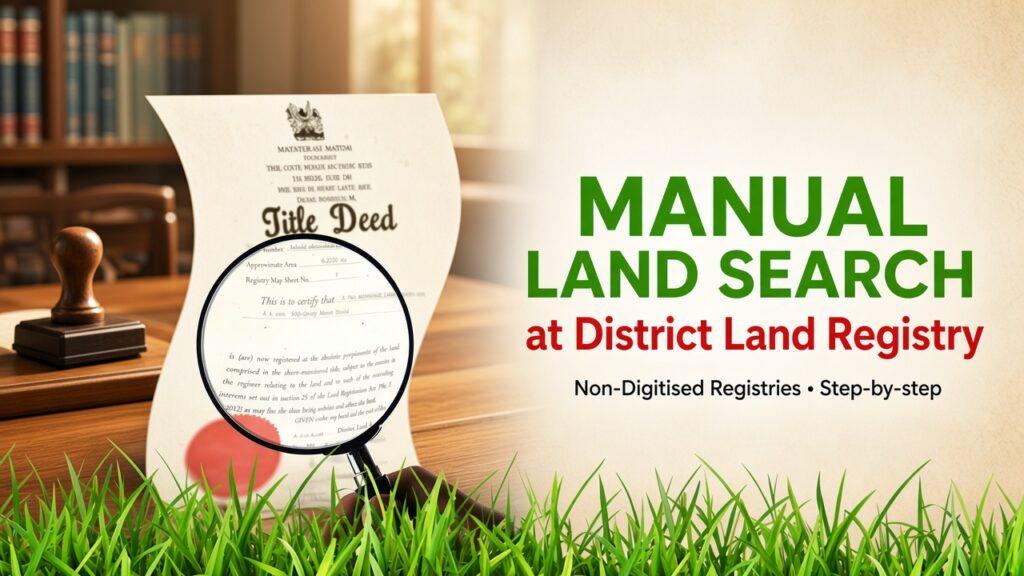
Manual Search at a Non-Digitised District Land Registry
- Visit the District Land Registry where the property is located.
- Complete Form RL 27 (Application for Official Search) in duplicate.
- Attach a copy of the title deed, the seller’s national ID, and KRA PIN.
- Pay the statutory fee at the banking hall or via eCitizen.
- Collect the stamped Official Search Certificate (Form RL 26) signed by the Land Registrar.
How to Read a Search Certificate – Key Red Flags
- Registered owner: names and ID numbers must match the seller’s identity documents exactly.
- Approximate area: must match both the physical parcel and the sale agreement.
- Tenure: if leasehold, check the unexpired term many run on 99-year leases.
- Charge or mortgage: the property is loan collateral; the bank must issue a Discharge of Charge before any transfer. Our banking & finance law team handles this discharge process directly with lenders where needed.
- Caution or caveat: a third-party claim family dispute, unpaid creditor, or pending suit that must be resolved first, sometimes through commercial litigation or debt recovery action if the competing claim doesn’t resolve amicably.
- Prohibition or inhibition order: a court order barring any dealing on the property.
Note: Never pay a deposit if the search reflects an active caution, restriction, or undisclosed charge without a formal legal resolution in place.
Beyond the Registry Search: Checks an Advocate Adds
A registry search only confirms who owns the title on paper. To fully protect a purchase, a conveyancing advocate will also run:
- Registry Index Map (RIM) and physical beacon verification – a licensed surveyor confirms the land physically exists where claimed and does not encroach on road reserves or neighbouring plots.
- Historical title (Green Card) audit – tracing every transaction on the parcel from original allotment to catch forged entries or illegal subdivisions, especially important for high-value or historically contested land.
- Land rates and land rent clearance – confirming there is no outstanding county or national government liability attached to the parcel, since unpaid rates form an automatic lien.
Frequently Asked Questions
Can a title deed search be conducted without the seller’s consent in Kenya?
No. On Ardhisasa, the registered owner receives a notification and must approve the search request before results are released. If a seller refuses or repeatedly delays giving consent, treat that as a serious warning sign rather than a technical delay.
What is the difference between a Title Deed and an Official Search Certificate?
A title deed is the ownership document held by the landowner. An Official Search Certificate is issued directly by the Land Registrar and shows the real-time legal status of that title current owner, size, tenure, and any charges or restrictions at the moment the search is run.
How long is an Official Search Certificate valid in Kenya?
It does not technically expire, but a certificate is only a snapshot in time. Advocates typically require a fresh search issued within 30 days of signing a sale agreement, since new charges or caveats can be registered at any point.
How much does a land search cost in Kenya?
An official search currently costs in the region of KES 500 to KES 1,000 per parcel, payable via M-Pesa, card, or bank transfer through Ardhisasa or eCitizen. This is a small fraction of what a buyer risks losing by skipping the step.
Can I verify a Kenyan title deed if I live outside the country?
Yes. Ardhisasa searches can be initiated from anywhere, but the practical steps obtaining the correct parcel details, interpreting the results, coordinating a physical boundary check, and following up on consent are difficult to manage remotely. Diaspora buyers typically instruct a Kenya-based advocate to run and interpret the full verification on their behalf.
What should I do if a search reveals a caution, charge, or restriction?
Do not pay a deposit or sign further documents until it is resolved. A charge usually means the property is collateral for a bank loan and requires a formal discharge before transfer our banking & finance law team can coordinate this with the lender. A caution or restriction signals a competing claim or court order that needs legal review, and occasionally litigation to clear title, before you proceed.
When does a merger or acquisition need Competition Authority of Kenya approval?
Mergers and acquisitions that meet or exceed statutory turnover or asset thresholds set by the Competition Authority of Kenya require its approval before the transaction can be completed. An advocate can confirm early whether your transaction falls within these thresholds, since proceeding without clearance where required can unwind a completed deal.
Don’t want to run this yourself?
Send us the title number and a copy of the seller’s ID on WhatsApp. Our property law team runs the official search, the boundary and Green Card checks, and sends you a plain-English verification report usually within 48 hours.
Schedule a Free Consultation — or read more about our Conveyancing & Real Estate services.
Contact
WhatsApp: 0710942629 / 0736677646 / omaadvocates@gmail.com / info@omaadvocates.co.ke
Office
A.C.K. Garden Annex, 1st Ngong Avenue, Ground Floor, Suite 04, Upper Hill, Nairobi, Kenya
Open Hours
Monday-Saturday 8 am – 5pm
Weekends on Appointments only.