Call/ WhatsApp us: 0710942629 / 0736677646 Email: omaadvocates@gmail.com


Owed Money in Kenya? Learn how the Small Claims Court Can help you get It Back in 60 Days
If someone owes you up to KES 1,000,000 for unpaid goods or services, a contract, damaged property, or a similar civil claim Kenya’s Small Claims Court is built to resolve it in a median of 60 days, without needing a lawyer, for a modest filing fee. It can’t handle employment, land title, defamation, or (despite how it might look) rent disputes. Here’s exactly how it works, and when it’s still worth having a lawyer involved even though the court doesn’t require one.
Most people who are owed money in Kenya either write it off, chase it informally for months, or assume court means a lawyer, a year of hearings, and fees bigger than the debt itself. For claims under KES 1 million, none of that has to be true anymore. The Small Claims Court, established under the Small Claims Court Act, 2016 (as amended in 2020) and rolled out from 2021, was built specifically to fix this presided over by an Adjudicator with at least three years’ legal experience, using simplified procedure and no strict rules of evidence.
How to File a Case in Small Claims Court
Understanding how to file a case in Small Claims Court is essential for any individual or business looking to resolve a dispute efficiently in Kenya. At Ondieki & Matoke Company Advocates, we’ve guided clients through this process directly, and the pattern is consistent: filing a case takes more than completing a form. It requires accurate documentation, proper service of the Memorandum of Claim, and a clear approach to presenting evidence. Claimants who get these steps right ideally with experienced legal guidance behind them meaningfully improve their chances of a favourable outcome.
The goal of this guide is to make the process genuinely usable, not just to summarise the Act. Every procedure and enforcement step below has been checked against current Kenyan law and how the court actually operates in practice, rather than repeated from a generic overview so you’re working from something you can act on directly.
For individuals, small business owners, and professionals, knowing the correct procedure prevents avoidable delays, reduces unnecessary legal costs, and puts you in a stronger position to pursue what you’re owed with confidence.
What the Small Claims Court Can and Can’t Handle
| The court CAN handle | The court CANNOT handle |
|---|---|
| Contracts for sale/supply of goods or services (e.g. an unpaid invoice) | Employment disputes these go to the Employment and Labour Relations Court |
| Contracts relating to money held or received | Land title disputes these go to the Environment and Land Court |
| Liability in tort for loss or damage to property | Malicious prosecution or defamation claims |
| Recovery of movable property | Rent and rent arrears confirmed by the High Court in 2023 despite superficially looking like a money-related contract claim |
| Compensation for certain personal injuries | Certain personal injury claims better suited to ordinary civil procedure |
| Set-off and counterclaim under any contract | Any claim where the total value exceeds KES 1,000,000 |
If your matter falls into one of the excluded categories, it isn’t a dead end it just belongs somewhere else. Employment claims go through the Employment and Labour Relations Court, where our employment & labour lawyers can help; land title disputes go through the Environment and Land Court, which our conveyancing and real estate lawyers handle; and anything requiring negotiated settlement rather than a ruling can often be resolved faster through our dispute resolution and mediation practice.
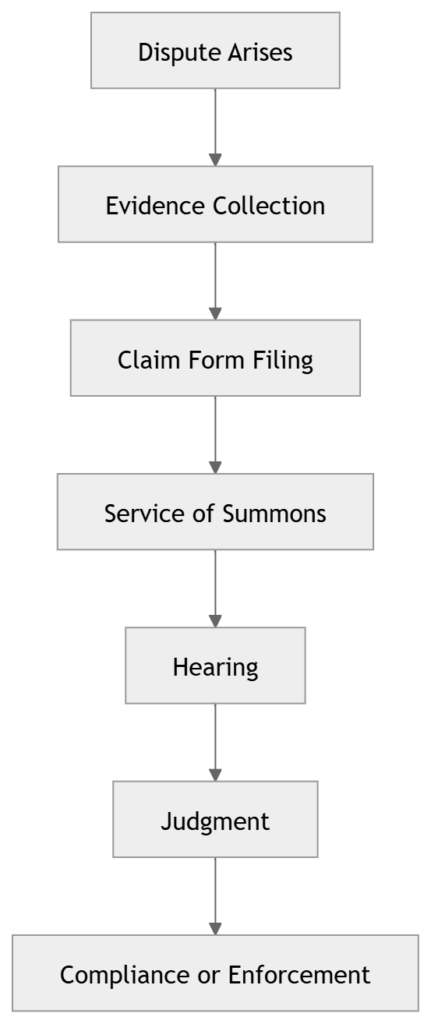
How to File a Claim, Step by Step
1. File Your Memorandum of Claim
Complete and file a Memorandum of Claim at the court registry, along with the prescribed filing fee a modest, tiered fee based on your claim amount rather than a single flat rate. The court then issues a Mention Notice setting the date, time, and presiding Adjudicator.
2. Serve the Respondent
You must serve the Memorandum of Claim on the Respondent and be able to prove it the court will not make final or adverse orders without proof of service. Acceptable methods include physical service, email, and even WhatsApp.
3. Wait for a Response (14 Days)
The Respondent has 14 days from service to file a response. If they don’t respond at all, you’re entitled to a default judgment in your favour. If they admit part of the claim, that part becomes a binding court order immediately, and only the disputed portion proceeds to hearing.
4. Hearing Oral or Documents Only
If the case is contested, you can choose to proceed by Viva Voce (oral evidence in person or via approved electronic means telephone or videophone) or under Section 30, by documents only, where the Adjudicator decides based on written submissions and evidence alone. Formal rules of evidence are relaxed throughout.
5. Judgment, Costs, and Enforcement
The court can award costs to the successful party. If the losing party (the judgment debtor) doesn’t pay voluntarily, the court can order execution attachment and sale of property, or attachment of salary to enforce the decretal sum. This enforcement stage is often where a self-represented claimant benefits most from legal help, since collecting a judgment is frequently harder than winning one; our commercial litigation and debt collection lawyers handle enforcement specifically.
Visual Overview of the Process
Can You Appeal?
Not in the usual sense. The Adjudicator’s decision is final, though you can apply to the High Court for a review limited strictly to matters of law not simply because you’re unhappy with the result and that review decision is itself final.
Not sure if your claim even qualifies?
Tell Ondieki & Matoke Company Advocates who owes you what, and why. We’ll tell you in minutes whether Small Claims Court is the right route or whether it’s actually excluded, like rent disputes often are.
WhatsApp/ Call us on 0710 942 629
When It’s Still Worth Involving a Lawyer
- Drafting the Memorandum of Claim to actually capture the full, recoverable amount and the right legal basis an incorrectly framed claim can be dismissed or undervalued.
- Confirming your claim actually qualifies as the rent example above shows, a claim can look eligible and still be thrown out for lack of jurisdiction, wasting your filing fee and the 14-day service window.
- The other side hires a representative and you don’t want to be at a disadvantage.
- Enforcing a judgment once you’ve won attachment and execution proceedings have their own procedure, and a judgment that can’t be enforced is worth nothing on paper.
Frequently Asked Questions
What is the maximum claim I can bring in Small Claims Court in Kenya?
KES 1,000,000. If your claim is worth more than that, you can either take it to a higher court, or abandon the amount above KES 1,000,000 and proceed in Small Claims Court for the capped amount though that means permanently giving up the excess.
Do I need a lawyer for Small Claims Court in Kenya?
No, the court is designed for parties to represent themselves, or use a non-lawyer representative with written authorisation. That said, a lawyer can still help you draft a stronger Memorandum of Claim, gather the right evidence, ensure proper service, and often the harder part actually enforce the judgment afterward if the other side doesn’t pay voluntarily.
How long does a Small Claims Court case take in Kenya?
The court targets a median resolution time of 60 days or less, which is dramatically faster than ordinary civil litigation. Simple, well-documented claims with proper service tend to move fastest; disputes where the respondent contests everything take longer.
Can I appeal a Small Claims Court decision in Kenya?
Not in the ordinary sense the Adjudicator’s decision is final. You can, however, apply to the High Court for a review, but only on matters of law (not simply because you disagree with the outcome), and the High Court’s decision on that review is final.
Can Small Claims Court handle a rent dispute?
No. Even though unpaid rent might look like “money held or received,” the High Court has confirmed that rent and rent-arrears disputes fall outside the Small Claims Court’s jurisdiction and must go through the ordinary Magistrate’s Court or High Court process instead.