Call/ WhatsApp us: 0710942629 / 0736677646 Email: omaadvocates@gmail.com
Dispute Resolution Advocates in Nairobi, Kenya
Dispute resolution law covers the rules and methods used to settle legal conflicts and disagreements, whether outside the courtroom entirely or through the formal court system itself. Not every dispute needs a trial often the fastest, most cost-effective, and most confidential route to a resolution is negotiation, mediation, or arbitration. At Ondieki & Matoke Company Advocates, we help clients choose the right method for their dispute and represent them through it, from a straightforward negotiation to formal arbitration or, where necessary, litigation.
The Legal Framework
- Article 159 of the Constitution — Article 159(2)(c) directs courts and tribunals to promote alternative dispute resolution ADR isn’t a fallback option in Kenyan law, it’s a constitutionally encouraged first choice.
- The Arbitration Act, 1995 — The primary legislation governing arbitration in Kenya, setting out how arbitration agreements are formed, how proceedings are conducted, and how arbitral awards are recognised and enforced.
- Court-Annexed Mediation — Kenyan courts increasingly refer suitable cases to court-annexed mediation before or during litigation, reflecting the constitutional push toward ADR even within the formal court system.
- The Intergovernmental Relations (ADR) Regulations, 2022 — Sets out specific ADR mechanisms for resolving disputes between public bodies and levels of government.

The Court System (Litigation)
- Hierarchy — Kenya’s court structure runs from the subordinate courts up through the High Court, the Court of Appeal, and finally the Supreme Court.
- Specialised Courts — The Environment and Land Court and the Employment and Labour Relations Court handle disputes specific to their sectors, operating at the same level as the High Court within their jurisdiction.
- Tribunals — Bodies such as the Tax Appeals Tribunal resolve specific categories of dispute at first instance, before a matter can be escalated to the High Court.
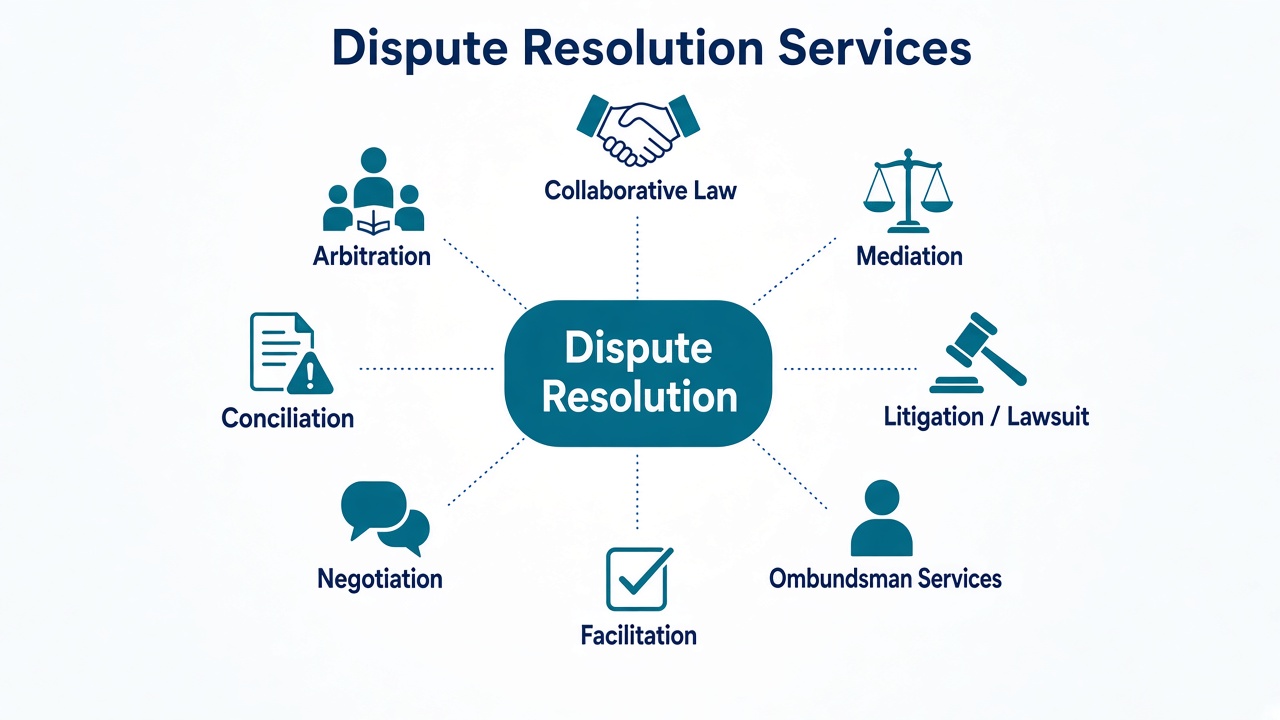
Alternative Dispute Resolution (ADR) Methods
| Method | How It Works | Outcome |
|---|---|---|
| Negotiation | Parties communicate directly, without a third party, to reach a resolution. | A voluntary agreement reached entirely by the parties themselves. |
| Mediation | A neutral mediator facilitates discussion between the parties, without deciding the outcome for them. | A voluntary settlement, only if both parties agree to it. |
| Conciliation | Similar to mediation, but the neutral conciliator takes a more active role, proposing possible solutions. | A voluntary settlement, guided more directly by the conciliator’s suggestions. |
| Arbitration | An independent arbitrator or panel hears both sides and issues a decision, governed by the Arbitration Act, 1995. | A final, legally binding award, enforceable much like a court judgment. |
| Litigation | The dispute proceeds through the formal court system before a judge. | A binding court judgment, with rights of appeal through the court hierarchy. |
Traditional Mechanisms — Communities may resolve disputes through local customary practices, provided these do not conflict with the Bill of Rights a real but bounded option in certain contexts.
Our Dispute Resolution Services
- Commercial Arbitration — Representing clients in commercial arbitration proceedings, from drafting the arbitration agreement through to enforcing the final award.
- Mediation & Conciliation — Representing clients in mediation and conciliation, aiming for a resolution that avoids the cost and delay of a full dispute.
- Negotiation Support — Advising on strategy and representing clients in direct negotiations before a dispute escalates further.
- ADR Clause Drafting — Drafting arbitration and mediation clauses into commercial contracts, so the right dispute resolution path is already agreed before any dispute arises.
- Litigation Support — Representing clients in court where litigation is genuinely the right route, or where ADR has been attempted without success.
- Intergovernmental & Public Body Disputes — Advising public bodies and their counterparts on ADR mechanisms specific to intergovernmental disputes.
Why ADR Is Often the Better Starting Point
Modern legal systems, including Kenya’s, strongly encourage ADR to reduce court backlogs and lower the cost of resolving disputes. Arbitration and mediation are typically faster and more confidential than litigation, and they let parties choose a decision-maker with relevant expertise rather than whichever judge is assigned to their case. That said, ADR isn’t always the right fit some disputes genuinely need the authority and precedent-setting function only a court can provide, which is exactly the kind of judgment call worth making with an advocate early, not after months have already been spent on the wrong process.
Why Ondieki & Matoke Company Advocates
- Direct access to your advocate throughout not a call centre or a junior clerk.
- Honest guidance on which dispute resolution method actually fits your situation, not a reflexive push toward the most expensive option.
- Experience across the full spectrum — negotiation, mediation, arbitration, and litigation so the strategy is chosen for your dispute, not limited by what we happen to offer.
- A transparent process and fee structure, explained clearly before work begins.

What to Expect — Our Process
- Initial consultation — you share the nature of your dispute and what outcome you’re looking for.
- Strategy — we advise on the most suitable resolution method, weighing cost, speed, confidentiality, and the strength of your position.
- Engagement — we represent you through negotiation, mediation, or arbitration, or prepare litigation where that’s the right path.
- Resolution — we work toward a settlement, arbitral award, or judgment, whichever the chosen process delivers.
- Enforcement — where necessary, we help enforce a settlement, award, or judgment that isn’t voluntarily honoured.
Frequently Asked Questions
What is the difference between arbitration and mediation in Kenya?
In mediation, a neutral mediator helps the parties reach their own voluntary agreement but does not decide the outcome. In arbitration, an independent arbitrator hears both sides and issues a final, legally binding decision, similar in effect to a court judgment.
Is an arbitration award binding in Kenya?
Yes. Under the Arbitration Act, 1995, a valid arbitral award is final and binding on the parties, and it can be enforced through the courts much like a court judgment if a party fails to comply voluntarily.
How do I start an arbitration process in Kenya?
Arbitration typically begins under an arbitration clause already contained in a contract, or by mutual agreement between the parties after a dispute arises. The process then involves appointing an arbitrator or panel, exchanging submissions, and a hearing, before the arbitrator issues a binding award.
When should I choose litigation over ADR?
Litigation is often the better route where you need a binding legal precedent, where the other party is unlikely to engage genuinely with ADR, or where urgent court orders (such as an injunction) are needed to prevent immediate harm. For most commercial disputes without these features, ADR is worth seriously considering first.
Is ADR cheaper than going to court in Kenya?
Generally, yes negotiation and mediation in particular tend to resolve disputes faster and at lower cost than full litigation, since they avoid extended court timelines and multiple hearings. Arbitration can still involve significant cost for complex disputes, but it typically remains faster than working through the court hierarchy.
Call now for a Free Consultation
Contact
0710942629 / 0736677646 / omaadvocates@gmail.com / info@omaadvocates.co.ke
Office
A.C.K. Garden Annex, 1st Ngong Avenue, Ground Floor, Suite 04, Upper Hill, Nairobi, Kenya
Open Hours
Monday-Saturday 8 am – 5pm
Weekends on Appointments only.